How long is 100 Feet? 12 Things That Are 100 Feet Long
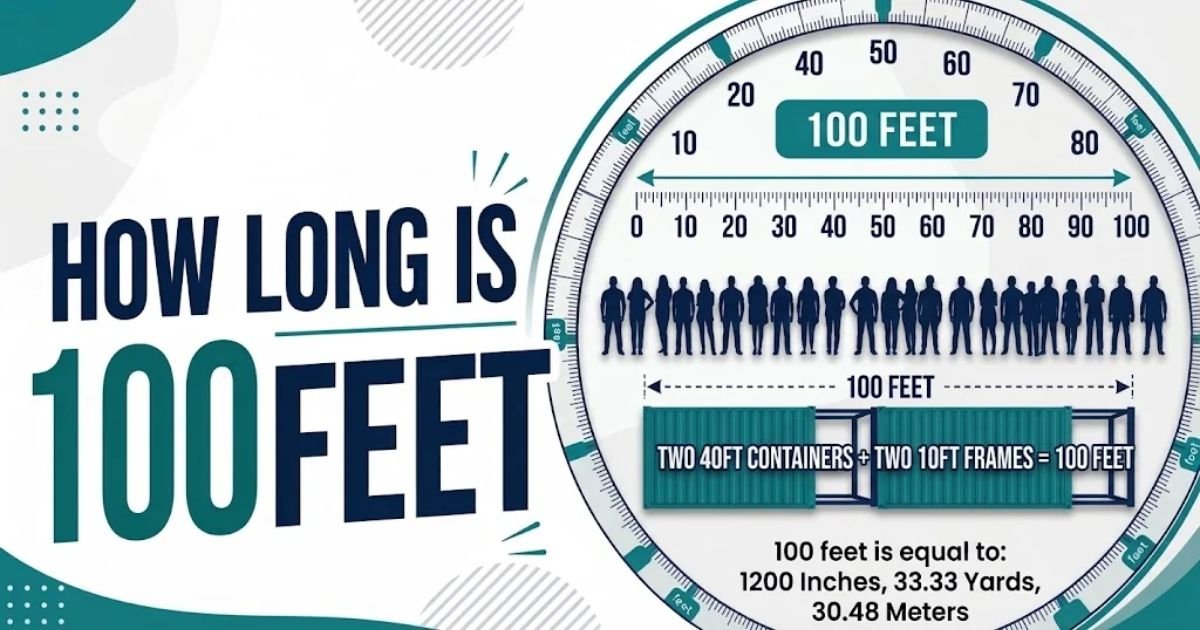
How long is 100 feet? It’s 30.48 meters, or 1,200 inches. Picture a 100-yard American football playing field: 100 feet is about one-third of its length, measured between the goal lines.
That comparison makes the distance easier to imagine, but 100 feet can still feel different depending on the setting. Along a street, it’s a substantial stretch; across a large room, it would be far too long to span. The examples below offer more familiar ways to picture that distance
How Long Is 100 Feet?
100 feet equals 1,200 inches, 3,048 centimeters, or 30.48 meters. These conversions express the same length in different units, so you can use whichever measurement best fits your needs.
For a quick reference, multiply feet by 12 to get inches; 100 × 12 = 1,200. In metric units, 100 feet is 30.48 meters, or 3,048 centimeters.
Conversion Table
| Unit | Value |
| Feet | 100 ft |
| Inches | 1,200 |
| Centimeters | 3048 |
| Meters | 30.48 |
| Yards | 33.33 |
| Millimeters | 30,480 |
How Big Is 100 Feet?
On a standard American football field, that’s a little over a quarter of the full 360-foot length, including the end zones an easy way to picture just how far it is.
For everyday measuring, imagine a straight line stretching about 30 meters from one point to another. That can help you estimate a long driveway, a large room, or the distance across an open area, though the exact comparison depends on the space.
What 100 Feet Feels Like
One hundred feet is far enough to feel like a real stretch, but close enough to keep the other end in view. Picture roughly one-third of a football field, or the length of a short city block though the exact comparison depends on the field or street.
On foot, that distance gives you time to notice the space between where you are and where you’re headed: a few dozen steady steps, a brief walk across an open area, or a longer-feeling gap when you’re carrying something. The number becomes easier to grasp when you connect it to a place you know.
12 Things That Are Exactly 100 Feet Long
We will shortly describe 12 things that are exactly 100 feet long.
Four City Buses Lined Up

Four city buses lined up end to end would stretch about 100 feet. It’s a useful way to picture that distance: instead of imagining a long stretch of roadway, picture four buses nose to tail.
The comparison is approximate, since bus lengths vary, but it offers an easy visual reference for 100 feet.
Blue Whale (Maximum Recorded Length)
The blue whale’s maximum recorded length is 100 feet, making it one of the most striking examples of scale in the animal kingdom. That figure describes a recorded maximum, not the length of every blue whale; individual animals vary in size.
A 100-foot blue whale is roughly as long as a line of several cars, giving a sense of just how enormous these marine mammals can be. Their size is one reason blue whales remain a remarkable subject for anyone exploring the giants of the ocean.
According to the New Bedford Whaling Museum’s blue whale facts, adult blue whales in the Southern Hemisphere can reach lengths of 90–100 feet.
10-Story Building (10 Feet Per Floor Standard)
Using the standard estimate of 10 feet per floor, a 10-story building is about 100 feet tall. This simple calculation provides a useful starting point when comparing building heights or making a rough estimate from the number of stories.
The actual height can differ because floor-to-floor dimensions vary, and features such as a roof structure or parapet may add height beyond the story count. Treat 100 feet as an estimate, not a precise measurement; confirm the building’s documented height when accuracy matters.
Boeing 737 Wingspan
The Boeing 737 has a wingspan of 100 feet, measured from one wingtip to the other. That measurement gives a straightforward sense of the aircraft’s width when viewed from above.
Wingspan is one of the key dimensions to consider when comparing aircraft or assessing the space they require. For other dimensions, consult specifications for the particular 737 model.
Niagara Falls (Horseshoe Falls Height)
Horseshoe Falls, the largest of Niagara Falls’ three waterfalls, has a height of 100 feet. That figure offers a straightforward way to understand the scale of the water’s descent.
Height is only one part of the view: the broad curve of Horseshoe Falls gives the waterfall its distinctive shape. Together, the drop and sweeping outline make it a defining sight at Niagara Falls.
Statue of Liberty Pedestal Height
The Statue of Liberty’s pedestal stands 100 feet tall. That measurement refers to the pedestal itself, not the statue above it.
The pedestal is a substantial part of the monument’s overall height, so keep it separate when comparing the pedestal with the full Statue of Liberty.
Parking Spaces in a Row
A 100-foot stretch can fit different numbers of parking spaces depending on the width assigned to each space and whether the row needs extra room at its ends. To estimate capacity, divide the usable length by the chosen space width; first confirm the applicable design standard and local requirements.
For a precise count, use [insert approved parking-space width] and subtract any required end clearance from the 100 feet. That calculation gives a practical starting point before laying out the full parking area.
Football Field Section
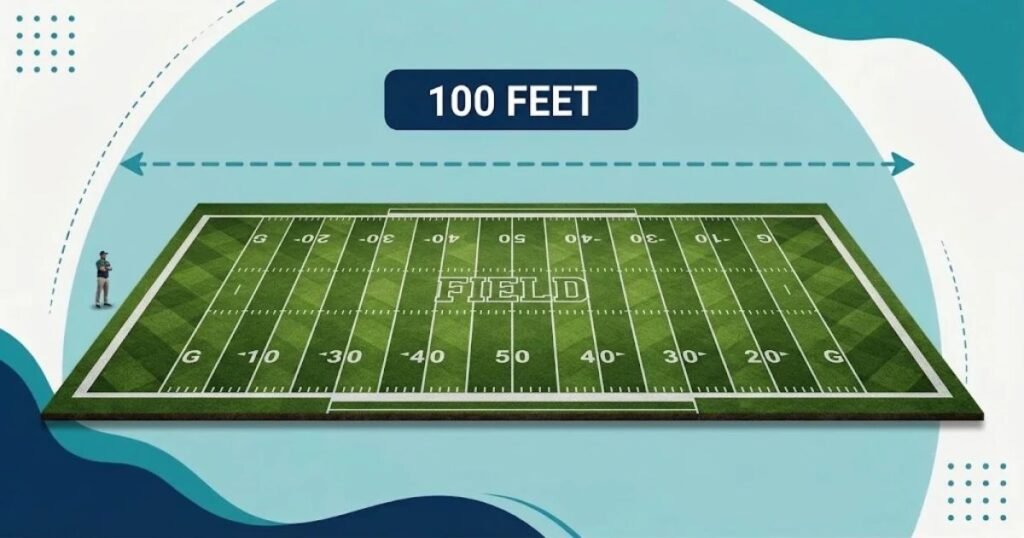
A 100-foot stretch covers 33⅓ yards—about one-third of the 100-yard playing field between the goal lines on an American football field. It’s a useful way to picture the distance without including the end zones.
For a simple comparison, imagine measuring from one yard line to a point just beyond the next 33-yard mark. The exact placement depends on where the 100-foot stretch begins.
Five Standard School Buses
Picture five standard school buses lined up end to end: together, they span 100 feet. That comparison turns an abstract measurement into a scene you can picture, whether you’re estimating a distance or imagining the length of a space.
The next time you encounter a 100-foot measurement, think of that row of buses as a quick visual reference.
10 Kayaks in a Row
A row of 10 kayaks stretches 100 feet in total. Before laying them out, decide whether that measurement includes the kayaks themselves, the gaps between them, or both; the distinction affects how much room the arrangement needs.
For a precise setup, measure the full row from its first kayak to its last, then adjust the spacing to fit the available area. [Add confirmed kayak dimensions or spacing guidance if available.]
The Base of the Great Sphinx
The base of the Great Sphinx gives a sense of the monument’s scale, but the supplied measurement of 100 feet needs a reference point before it can be stated accurately. A clear description should distinguish the base’s dimensions from the Sphinx’s height.
Once that measurement is confirmed, it can anchor a more precise account of the monument’s footprint and how its carved form meets the surrounding ground.
40 Human Paces
A distance of 100 feet is roughly 40 human paces. That makes pacing a handy way to picture the length when you don’t have a measuring tool nearby.
Treat it as an estimate, not a precise measurement: pace length varies from person to person. For accuracy, use a measuring tape or another measuring tool.
Read More: How big is 6 mm? 11 Common Things That Are Exactly 6mm Big.
How Tall Is 100 Feet?
100 feet is 30.48 meters, about the height of a 10-story building, depending on the height of each floor. It’s also just under one-third the length of an American football field, including the end zones.
Because buildings and fields vary, these comparisons are best used as a mental picture rather than an exact visual match. Think of 100 feet as a substantial vertical distance: high enough to make a person or object at the top look small from below.
How Far Is 100 Feet?
One hundred feet is 33⅓ yards, 1,200 inches, or about 30.5 meters. It’s a little shorter than the length of a football field, which measures 120 yards between the goal lines.
To picture the distance without a measuring tool, count it out in smaller sections: 100 feet is the length of ten 10-foot intervals laid end to end. Your stride can also help you estimate, but step lengths vary, so treat a step count as a rough guide rather than an exact measurement.
How to Measure 100 Feet Without a Tape Measure
Use your stride: First measure or otherwise establish the length of one normal step over a shorter, known distance. Then walk the 100-foot stretch, counting steps and using that stride length to estimate the total. Keep your pace consistent, and remember that this gives an estimate not an exact measurement.
Calibrate your pace over a known distance: If you know the length of a sidewalk section, driveway, or other nearby span, count how many steps it takes you to cross it. Use that result to estimate how many steps would cover 100 feet. This works best on level ground with a steady walking pace.
Repeat a known-length object: If you have an object with a reliable stated length, lay it end to end along the route, keeping each placement aligned with the last. Count each placement and add the lengths to estimate the distance; take care to avoid gaps or overlaps.
Mark off smaller sections: Use a shorter span you can estimate consistently such as your calibrated stride to mark out sections along the route, then count the sections until you reach the target. Combining this method with a known reference length can make your estimate more dependable.
The 100 Feet Challenge: Can You Beat It?
The name sets a clear distance, but the challenge itself depends on what you’re trying to do. Is it a race, a throw, a swim, or something else?
Before you take it on, clarify the starting point, finish line, and what counts as a successful attempt. If there’s a time limit or a safety requirement, include that too: a simple goal is more fun when everyone knows how it works.
Once the rules are clear, give it a try and see how close you get. The real test is not just covering 100 feet, it’s doing it by the challenge’s rules.
Conclusion
A 100-foot distance is easy to underestimate until you compare it with familiar things, such as a building, a vehicle, or a stretch of everyday space.
These comparisons make the measurement more useful for planning and visualizing. Next time you need to judge 100 feet, choose a nearby reference point and use it to picture the distance.
FAQs
How long is 100 Feet Compared to a Football Field?
A standard American football field is 300 feet between the goal lines, excluding the end zones, so 100 feet is exactly one-third (33.3%) of the playing field. Including both 30-foot end zones, the field is 360 feet long, making 100 feet about 27.8% of its total length.
What Does 100 Feet look like?
100 feet equals 30.48 meters or 33.33 yards. To picture the distance, imagine the approximate height of a 10-story building. This gives you a visual reference for how far 100 feet is, though it is an estimate rather than an exact measurement.
How long is a 100 Ft Walk?
Walking 100 feet typically takes about 17 to 25 seconds at a normal walking pace. The time may vary depending on a person’s pace and walking conditions, so treat this as a general estimate rather than an exact measurement. Your own walk may take less or more time.
How tall is 100 Feet Compared to a House?
100 feet is several times the height of a standard home.